Author: tm500
Loading Viewer…

Montana Cross Country T Assn.
7516 E. Mission Spokane, WA 99212
www.antiqueautoranch.com/montana500
2001 Officers and Directors:
President: Sam Nickol
Vice President: Rick Carnegie
Sec.-Treasurer: Janet Cerovski
Directors:
Tony Cerovski
Stan Howe
Doug Langel
George Nickol
Simon Nickol
Meeting Secretary: Carla Carnegie
Correspondence: Tom Carnegie
Membership dues $10.00
Cover picture: Original Ford ad for 1926
General News
The fall meeting will be held in Missoula this year at The Joker’s Wild 4829 N. Reserve. The date is Sunday, October 28th, 11:00 AM. We have the “room upstairs” reserved for us. We can order lunch at 11:00, and start the meeting as soon after that as we can. All members are urged to attend. Any rule changes and routes are proposed at this time. The Speedvision program was aired, and was enjoyed by many. I invited them to come back next year with more cameras crew and film. The printer cut off a paragraph on my summary in the last news letter. The full text appears on the web page. I was upset that I didn’t catch the mistake earlier because it was the part where I thanked the flaggers and timers for this year’s event. Thank-you again timers and flaggers. You did an excellent job. There are no drivers profiles this month, due to the length of the technical article. I will have more next time I believe. Some of you members have excellent writing skills. Please pick up a pen, and write a profile on a driver that you know. I and the other members would very much appreciate it. I’m not going to mention that I still haven’t found the results for 1963 & 1971, as it would just depress me.
A poor man’s balancer
by Tom Carnegie
One of the major tricks to making an engine run fast is to make it run smooth. With a Model T, this is a difficult task for several reasons. First of all, a four-cylinder engine without balance shafts will never run in true balance. This is because when the crankshaft is half way down (90 degrees off of top dead center) the pistons are more than half way down. The pistons actually move faster on the top half of their travel than on the bottom half. This may be hard for some people to visualize, but it is the case. One thing that sometimes helps illustrate this is to imagine an engine with its rod hanging loose. If you were to pull the piston exactly half way down the bore, and continue to let the rod hang, the crank hole in the rod would exactly line up with the main line. If you would turn the crank to its halfway point, it would be 90 degrees from top dead center. Now, if you were to hook the rod to the crank, without turning the crank, you can see that you would have to pull the piston down slightly to get it to hook up, as you swing the rod toward the crank. Having said all of that, there is a couple that occurs twice per revolution that can’t be relieved under normal circumstances. It can be mitigated though, by using the lightest rods and pistons that you can find. A couple is a rocking motion. A good example of a couple is two kids on a swing set. When one is forward, the other is back and vice versa. The force put onto the upper bar of the swing set is a “couple”. Other reasons for the balancing difficulty of a T engine have to do with the transmission. There are many parts like drums and clutches that move around, making a true balance all but impossible. Still, the closer you can get everything else, the better. This article will tell how to build a very accurate dynamic balancer for almost no money.
Balance, do!
For the assembly of this machine, you will need the following items:
- 3 – junk T engine blocks
- 4 – used T generator bearings
- 2 – Pieces of 2″ angle iron 3 1/2 inches long each
- 5 – 3/8″ X 1″ NF bolts
- 8 – 3/8″ flat washers
- 4 – 3/8″ lock washers
- 7 – 3/8″ NF nuts
- 2 – 7/16 X 3/4″ NC bolts
- 1 – No. 10 – 32 X 3/4″ machine screw
- 1 – old 28-9 Model A or Model T bumper bar
- 1 – 3-lb. coffee can with lid.
- 1 – 3/8″ rod 7-1/2″ long
- 1 – circle of tin 5″ in diameter
- 1 – circle of tin 3″ in diameter
- 1 – set of distributor points
- 1 – ignition coil and coil wire
- 1 – condenser
- 1 – timing light
- 1 – battery to operate timing light and coil
- 1 – 1″ by 8″ long piece of strap iron
- 1 – 1/4″ diameter rubber bumper
- 1 – 3/8-drive variable speed drill motor
- 1 – an old starter or generator case
- 1 – 1/4″ ball bearing
- 1 – dial indicator
Scallop both pieces of angle iron as per the illustration. (fig 1.)

Drill two holes into each piece, for the bearings, and tap to 3/8″ NF. Drill a hole into the center of the bottom of the piece of angle iron large enough for a 7/16″ bolt. Into one of the two pieces, drill and tap a number 10 X 32 hole into the bottom front of the angle iron, as per the illustration. Bolt the bearings onto the angle iron pieces. (See pic. 2.)

pic. 1

pic. 2
The bearings need to be very clean, and must spin freely. Put a drop of oil into each bearing. Cut the bumper into a section 20″ long, and drill a 7/16″ hole 3/4 of an inch from each end. Bolt one roller assembly loosely to one of the T blocks. Bolt the bumper section snugly to another of the T blocks. Bolt the other roller to the other end of the bumper, loosely. Space the rollers out so that a Model T crankshaft will roll on the first and third main. (As per pic. 1.) Adjust the roller assemblies so that they are running true on the crank main, and then tighten them. Spin the crank clockwise, looking from the spring end. If the crankshaft “walks” left or right, move one of the blocks forward or back and try again. Carefully adjust the crankshaft until it spins freely, and just creeps to the left as it is rotated clockwise looking at the end that is sitting on the spring (the bumper piece). Put some grease on a 1/4″ ball bearing and stick it into the end of the crankshaft. Butt the ball up against the generator housing that you have sitting on the block. (See pic. 1) Place something heavy onto the generator housing to keep it in place. It is also handy to thread a bolt into the block for the generator case to butt up against to keep it from moving. Most unbalanced T cranks I’ v e tried will come to rest in heavy-part-down position if you set them on the rollers at this point. The next thing to build is the dashpot. What this does is dampen the action of the spring somewhat. It consists of a disk on a rod in a can of oil. (See fig 2)

You can make a couple of different sized disks to change the sensitivity of the balancer. The next thing to do is to make the point setup. Take a piece of 1″ strap, and twist it 90 degrees near the end. (See pic. 3)

pic. 3

pic. 4
Drill a 7/16″ hole near the end, to bolt the assembly to the block. Mount the points and condenser on in the manner of pic. 4. The machine screw needs to be adjusted so it is a few thousandths of an inch from the points when the item to be balanced (henceforth called the rotor) is in place . Wire a coil and battery to the points, and attach your timing light to the coil wire in the correct manner. Let the coil wire spark to ground in some convenient place. Don’t apply electricity to the coil until you are ready to begin balancing, as leavin g the electricity applied to the coil could cause it to overheat.
A Balancing Act
In order to balance the rotor, it must be spun. The way I do this is with a variable speed electric drill. Place a pointed piece of rubber into the drill, and the rotor can be spun by placing the rubber into the center on the end. Now, the cool thing about this balancer is that it can balance in two planes. I will explain what that means. Some people refer to dynamic and static balance. Please refer to pic. 5.

pic. 5

pic. 6
That is an axle shaft with a bolt welded onto it. If you were to gently spin the axle, it would always come to rest with the bolt down, as it is in the picture. Now, look at the axle in pic. 6. It has another bolt at the other end of the shaft welded just opposite the first bolt. However you turn this shaft, it will stay in that position. This is what some folks refer to as static balance. I do not like this term, as any static shaft has reached equilibrium, and therefore by definition is in balance. In order to be out of balance, the shaft must be turning. I prefer to use the term “balanced in one plane” or “balanced in two planes” in exchange for the terms “static” and “dynamic” balance. It is easy to see that if you consider the axle in pic. 6 as one plane its entire length, that it is in balance. If you divide the axle into two planes, a right plane and a left, splitting the axle figuratively in the middle, it is easy to see that each plane is quite out of balance, just as the axle in pic. 5 was. Our quest is to get our rotor balanced in two planes. To accomplish this, we balance it one side at a time. The rotor we are talking about in this case, is the crankshaft, which should be balanced with the pulley and crank gear on it. As I mentioned earlier, when you place the rotor into the machine, it will probably come to rest in the same place every time you spin it. In fact, it may be so out of balance, that even at a moderate speed of rotation, it will try to jump out of the rollers. What I do, is to get it into reasonable balance in one plane first. Note the heavy spot. It will likely be two of the four rod throws. Grind or drill away some metal on the heavy spots, and try again. At a point in time, the rotor should stay at any position you put it. You are now ready to begin balancing in two planes. Use the large dashpot disk at first. As the rotor comes into better balance, substitute the small disk for greater sensitivity. On the end of the rotor make three marks as per fig 3.


fig. 3 fig. 4
Place a dial indicator on top of the spring as in pic. 1. Spin the rotor, and adjust the point screw so that the timing light just flashes at the point of maximum imbalance. This point can be noted on the dial indicator. As you spin the rotor, it will be relatively smooth, then will become rough, and then will smooth out again. There is no need to spin it above the speed at which it smoothes out. Spin the rotor up, and as it slows, watch the flashing of the timing light. One of the marks should appear to stand still 90 degrees to the right of top (1. in fig 4) then, as the rotor slows, the mark will appear to rotate anti-clockwise until it is at the top when the point of maximum vibration is reached (2. in fig 4). As the rotor continues to slow, the mark will appear to rotate 90 more degrees to the left as the rotor slows to below the imbalance speed (3. in fig 4). Where the mark appeared at the moment of maximum imbalance is the light spot. That means that you need to take off material opposite this and in the plane in which you are working. There are two rod throws in each plane, and normally one of these will be down when the balance mark is up. If it is the rod throw closest the end, you will have to take off less material than if it is the other, as it is farther out on the plane we are balancing at this time. After a few times, turn the rotor end for end and balance the other plane for a while. As you get the rotor closer and closer to being in balance, you may encounter the situation where the rod throws are parallel to the ground. When this happens, you must drill the flange or the timing gear or the pulley. When you get to the point that the dial indicator is only moving one or two thousandths of an inch at the roughest spot, then you are probably close enough. The machine I built was admittedly a little crude. With a little adapting, a permanent machine could be made to do a whole host of balancing projects. I built mine out of old T blocks because they were handy, and quick. It was also an experiment, but it worked well enough to give me incentive to refine it, and perhaps make it more permanent.
A question of balance
They say the proof is in the pudding. When I got to the point that my rotor was only out of balance a few thousandths on the indicator, I decided to see just how good it was on a commercial machine. Jack Bunton of Vintage Engine Machine, has a Stewart-Warner precision balancing machine, which he kindly let me use to check my work. The scale on his machine goes from 1 to 10. Anything under 1 is considered acceptable. My crank registered just two tenths. This is the level of balance that you would expect on high revving racecar motors. The pudding is quite good indeed, and inexpensive too.

Montana Cross Country T Assn.
7516 E. Mission, Spokane, WA 99212
2001 Officers and Directors:
President: Sam Nickol
Vice President: Rick Carnegie
Sec.-Treasurer: Janet Cerovski
Directors:
Tom Carnegie
Tony Cerovski
Stan Howe
Doug Langel
George Nickol
Simon Nickol
Meeting Secretary: Carla Carnegie
Correspondence: Tom Carnegie
Membership dues $10.00
Cover picture: East Glacier, third day of 2001 Endurance Run. Picture taken by Paul Marx.
Page 2
General News
The 2001 endurance run is over. It was won by Ron Miller. Ron is my kind of model T guy. I understand that he had his head off his motor 17 times, the last time in the parking lot at the hotel before the race. I on the other hand broke my seal from the year before only because I couldn’t get my car to go onto the trailer. I have vowed to be better prepared for next year!
Normally the number after your name indicates through what year your dues are paid. I have not updated after the race, so some people’s numbers may be out of date. I will try to get synched up with Janet by the next newsletter.
The people from ESPN were there at the race, video taping. The show is scheduled to air August 13th on a show called “Car Crazy”. If you have cable, you might want to check your listings to find out when it will be shown.
This month, I have two more driver’s profiles, including one written by the cast-iron champ, Rich Armstrong. Rich is not made of cast-iron, but his T had pistons made of cast-iron for many years.
If anyone has photographs of past years that they can scan and e-mail to me, I would love to put them on the web page for all to enjoy. Speaking of the webpage, I still don’t have complete results for 1971. If anyone has this information, please let me know.
page 3
Compression Ratios
Here is some information that might be of interest to people. Thanks to Larry Young of Tulsa, Oklahoma for this. Larry cc’d various heads. These are the results he got. The total volume of the cylinder is 44.2 cubic inches. The total volume of the part of the piston that sticks up above the bore is 2.86 cubic inches. The head gasket holds .92 cubic inches. The total combustion chamber is the head volume minus the volume of the part of the piston that sticks above the bore, plus the volume of the head gasket. Using the stock head as an example: 17.9 minus 2.86 plus .92 = 15.96 cubic inches for the total volume of the combustion chamber. Cylinder volume plus combustion chamber volume divided by combustion chamber volume equals the compression ratio. (44.2 + 15.96)/15.96 = 3.77:1
The first number will be the head volume, the second will be the calculated compression ratio.
Stock head 17.9 = 3.77
Stock (milled 1/8″) 15.6 = 4.24
Waukesha-Ricardo 16.6 = 4.02
Z-head 13.7 = 4.76
Z-head (milled .050″) 12.8 = 5.07
Reeder 12.2 = 5.31
Now the same figures for an engine bored .060″ over.
Stock head 3.86
Stock (milled 1/8″) 4.34
Waukesha-Ricardo 4.11
Z-head 4.88
Z-head (milled .050″) 5.2
Reeder 5.44
Page 4
Summary of 2001 Montana 500 Endurance Run
by Tom Carnegie
Sunday was inspection day. Somehow the local newspaper had printed an article saying that the run proper began on Sunday, a misapprehension shared by some of the T drivers. Better too early than too late I guess. After we had inspected all the cars, we had our evening meeting and drew numbers. Rick Carnegie, last year’s winner was number one, and Rob Flesner, a newcomer this year, was the last car (a position he held the entire way) with number 18. We had four more or less touring cars. Peter Proschold from Las Vegas with his brass touring car, David Lingle with the roadster his dad Melvin drove, Keith Painter from Bountiful, Utah and Simon Nickol with his touring car. David and Simon had a little trouble, and didn’t tour with us too much, but Keith and especially Peter drove a lot of miles. I wouldn’t be surprised to see Peter back next year with a racer. Simon helped out with the trouble unit throughout the run. Monday morning in the rain, we headed out for Whitefish to flag out. The first leg saw the first T break down. It was Ted Ballard with rear axle troubles. Ted was driving a car that used to belong to Orrin Culross of Culver City, California. Orrin used to race in the mid ’70’s. The next casualty was on leg three when Tom Carnegie’s crankshaft broke. Tom was in second place at the time. The rest of the first day was uneventful, until after the last leg, Nan Robison’s rear axle started making funny noises. Since Tom’s car was dead in the water it was
(Continued on page 6)
page 5
(Continued from page 5)
decided to cannibalize it. The rear axle assembly got put into Nan’s car, the radiator was put into Mike Robison’s car, as he had had radiator trouble all day, and the coils went into Rob Flesner’s car, as he had had coil trouble.
Day two saw the next catastrophe. Nan Robison’s car lost a magnet, which seized up the motor, just as she was attempting to pass a truck. Josh Billmayer was right on her tail, but managed to somehow avoid hitting her as she skidded to a stop along side of the road. Nan was in sixth place at the time. About noon, the crew from ESPN showed up and began to record the action. They stayed and taped until the end of day three. At the end of day two, Ron Miller was out in front followed by Doug Langel, then Steve Coniff.
Day three saw the last break down. Mike Robison’s borrowed radiator couldn’t take the stress, and blew up. Mike had to quit with just two legs of the run left to go. Mike was in tenth place at the time. Also on the third day, Harold Mann withdrew to tour Glacier Park. Harold was in fourteenth place at the time. During the course of day three, Steve Coniff and Doug Langel swapped places. After all the times were compiled, we had a driver’s meeting where we decided against having a post-race tear down. President Sam Nickol presented Ron Miller with the first place trophy. Dave Huson generously donated a trophy for the best place finish by a female. It was awarded to Anna Marx. Anna finished tenth overall.
All in all, it was a great run, with good weather, a superb route and excellent timing and flagging. We had more entrants this year than we’ve had since the 1980’s. Next year we look forward to an even better Montana 500!
Page 6

page 7
John Foos
by Rich Armstrong
John Foos was reared in Laurel, Montana, but now resides in Helena. John entered his first race in 1961. He competed in the last two days of the Missoula to Circle race promoting Highway 200 through Montana. After the Montana Cross-Country “T” Assoc. was organized, John joined and participated in thirteen races through the 1980’s.
John was a fierce competitor! His motto-” I CHEAT”. This was more bluff than anything, as his generosity was very evident in that he never refused to assist anyone-
whether it is the need for a coil or EVEN the loan of a complete engine!
John served as President in 1966 and 1967. His wife, Donna, was Sec.-Treasurer.
Spontaneous response was one of John’s characteristics. During a race in the Flathead country, the weather was cold and very rainy. After two days of driving with no top on his roadster, and while stopped for coffee and trying to find shelter from the elements, a
young man driving a Model A Sedan stopped. He leaned out the window and asked John
if he would trade. John jumped up and said, “Get your junk out and you have a trade”.
Five minutes later, John was a proud owner of the A. John’s comment when asked why
he did it; “At least I’ll be dry”!
Page 8

page 9

Montana Cross Country T Assn.
7516 E. Mission, Spokane, WA 99212
2001 Officers and Directors:
President: Sam Nickol
Vice President: Rick Carnegie
Sec.-Treasurer: Janet Cerovski
Directors:
Tom Carnegie
Tony Cerovski
Stan Howe
Doug Langel
George Nickol
Simon Nickol
Secretary: Carla Carnegie
Correspondence: Tom Carnegie
Date of endurance run is June 17th
Membership dues $10.00
Touring class: $25.00
Endurance runner: $35.00
Cover picture: Evan Lingle, winner of the first Endurance Run. Picture taken in 1961. Thanks to David Lingle.
General News
Well, this is the last newsletter before the big event. If you haven’t done so already, it’s time to tune up those T’s! Sam’s phone number is (406) 431-5471 if you need to talk to him. You can also call me (Tom) at 509-535-7789. Hopefully everyone knows to meet at the Outlaw Hotel in Kalispell on June 17th. It is the Best Western Inn located at 1701 Highway 93 South. Some alternative accomodations are listed on the web page www.antiqueautoranch.com/montana500
In order to plan better, could you please signal your intentions for the run. There are three easy ways to let us know if you plan to attend.
1. Call (509) 535-7789 (day) or (509) 922-1805 (eve.)
2. E-mail: (montana500@antiqueautoranch.com)
3. Write (7516 E. Mission, Spokane, WA 99212)
would help us out a bunch, and we thank you kindly.
Thanks to Carl Walden for his fine article on touring along with the 500. Thanks to Steve Coniff for information about the Colorado group, and to David Lingle, son of Melvin, for the profile on his uncle, Evan Lingle. I would like to do a profile on every single driver who has run (over 150 of them). If anyone could contribute a little bit about someone whom they know or have driven against, or even about themselves, I would sure be much obliged.
(Continued on page 4)
page 3
(Continued from page 3)
Here is some driver information from the web page. The top five drivers, based on number of times that they have entered are: Bud Peters, Ray Habel, Doug Langel, Chuck Worthington and Rich Armstrong.
Does anyone have pictures from the 1967 race? I am hoping someone has a shot of Hugo Rintala’s car to show what his hometown is. I also still don’t have complete results for 1971 or 1963. If anyone could dig deep for this information, it would bring me extreme peace of mind.
The route this year will be as follows:
Day one: Kalispell to Eureka to Libby to Kalispell
Day two: Kalispell to Seeley Lake to Kalispell
Day Three: To West Glacier then to East Glacier
This is subject to change due to road construction and such like that.
page 4
Touring Montana 500
By Carl Walden
After years of trying to connect with Rick and Tom Carnegie to attend the Montana 500, last year the right circumstances came together. I had just finished a major rebuild of my 1914 touring engine. A 500 mile run would be a good way to break it in.
Also my son Sean and his family were going to vacation with us from Hawaii. Sean has been in the Navy since 1989 and had not attended any antique car events in that time. He was really looking forward to an old car outting. Sean also loves racing, so the Montana 500 promised to be perfect all around. Sean, Nettie and their two sons, Christopher and Trevor, planned to use our 1931 Model “A” Tudor, which is ideal for a family with two little boys.
We trailered the cars from west of Spokane to Great Falls, the hub of the 500 mile run. We settled into a nearby RV park, then found the hotel where the tour was based to finish registering and visit.
After dinner that evening, we had a drivers’ meeting to go over details of the run.
(Continued on page 6)
Page 5
(Continued from page 5)
Every driver drew a placement number, even the tourers.
The next morning, we drove to the outskirts of Great Falls, where we were sent off one by one under the clock. We who were “tourists” were timed out before the competitors. Since we had never attended a Montana 500 before, we were under the impression we would tour a different route to a viewing area to watch the racers whiz by, then would drive to another place to see them again. We were surprised to learn we were to run the same route as the competitors!
The first leg was to Havre and back, which was almost half of the 500 miles. This run proved to me why Montana is known as Big Sky Country. Here the land is flat and windy and very splendid.
My ’14 with its new motor was pretty slow at first. As the event progressed, we were able to run at a more reasonable rate. Like I said before, we “non-racers” were sent off first. It was fun to have the racers catch and pass us during each leg. To participate in this way was like being in the grandstand and on the speedway at the same time – lots of fun!
When the 500 was over, we had another get-
(Continued on page 7)
Page 6
(Continued from page 6)
together to find out final times and winners. I was particularly proud of Carla Carnegie for driving her dad’s roadster the whole way and placing so high in the standings. No one was even sure the car would finish the race!
After the official 500 Endurance Run was over, we toured Glacier National Park. Patty and I had the pleasure of chauffering Gary and Kathleen Ebbert through the park. Glacier is a national treasure which words cannot describe! After saying our goodbyes to old and new-found friends, we went our separate ways. Our son Sean, still talks of how much fun they had during those few days in June in Montana. I am looking forward to the day when I can fix a “T” for competition. Unfortunately it won’t happen this year. In January I started a new job with a six month trial service time which, of course, includes June. But, like the Jews have said for centuries, “Next year in Jerusalem,” so it is for us: “Next year in Montana.”
(the end)
Page 7
Evan Lingle
By David Lingle
Evan was a born mechanic like his older brother Melvin, so he had a role model from the start. Fords were his favorite, starting with the model T’s.
When Evan was 18, he went off to serve in WWII. When he returned he went to work for the Montana State Highway. Later, he went to work for Berg Ford Motor in Circle, MT. There he had the opportunity to do what he really enjoyed, working on cars.
Berg Motors sponsored him in the first Montana 500 race in 1961. He took first place. Evan with the help of his son John, took a 1922 touring, cut the back off, put on two coats of black paint and called her good. “Pretty doesn’t win races” Evan was heard to say. He was a terrific, but fair competitor. Many of the other drivers teased him (good naturedly) about the T using more oil than gas. It used 23 quarts of oil. At one point in the race, a Montana Highway Patrol officer clocked him at 72 miles per hour (this is according to my mother Ruby Lingle). He was featured on the cover of Hemmings Motor News shortly after the race.
He entered several shorter races around Montana, many of them sponsored by the VFW of Jordan, MT. I remember when he borrowed my dad’s (Melvin Lingle) T for the 1972 Montana 500. Over the years he received many trophies, which his daughter, LaWanna of Billings MT. still cherishes.
He donated the last T he restored to the museum in Circle, MT. Evan passed away November 15, 1993.
Page 8
Joe Wilkinson
by Steve Coniff and Tom Carnegie
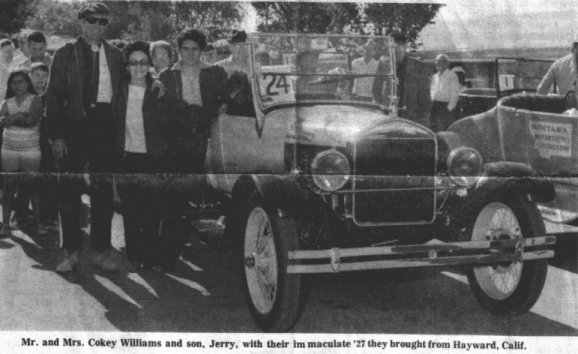
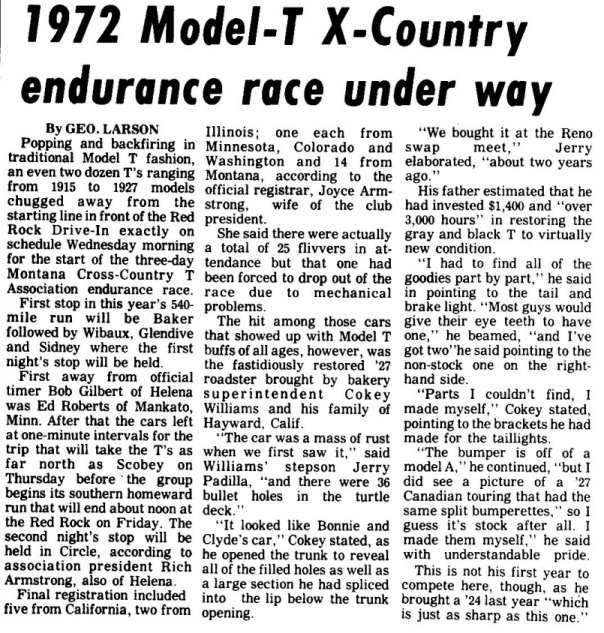
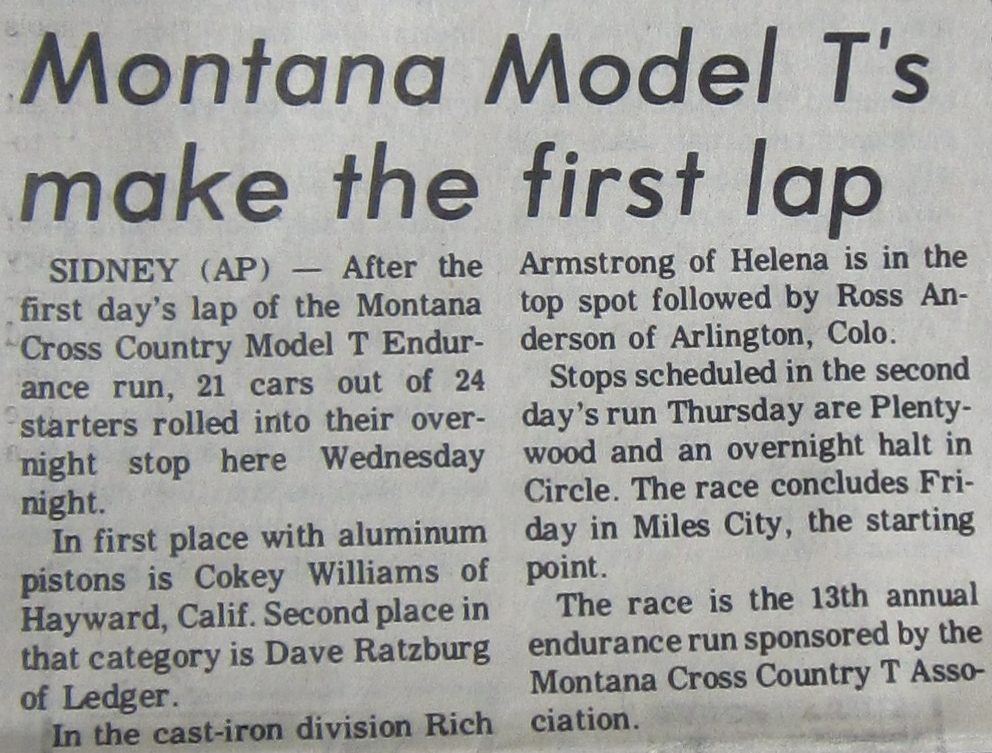
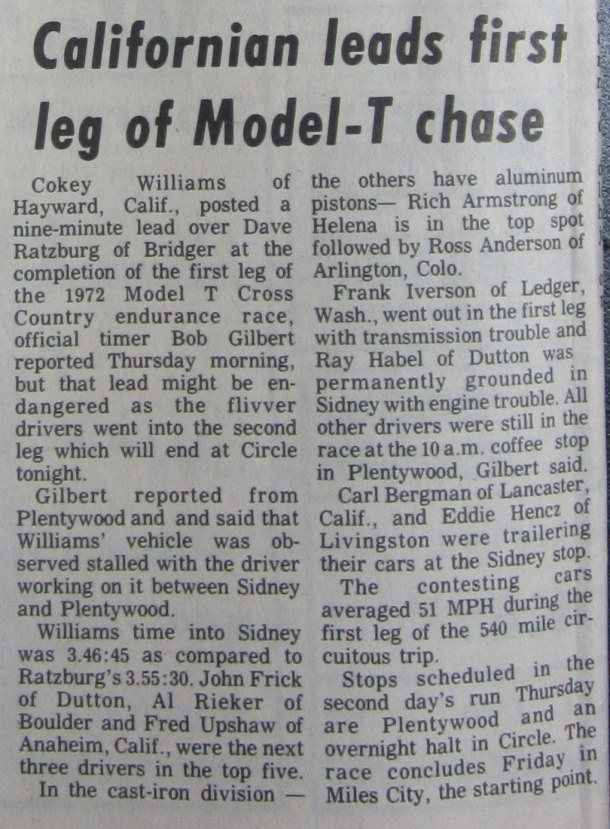
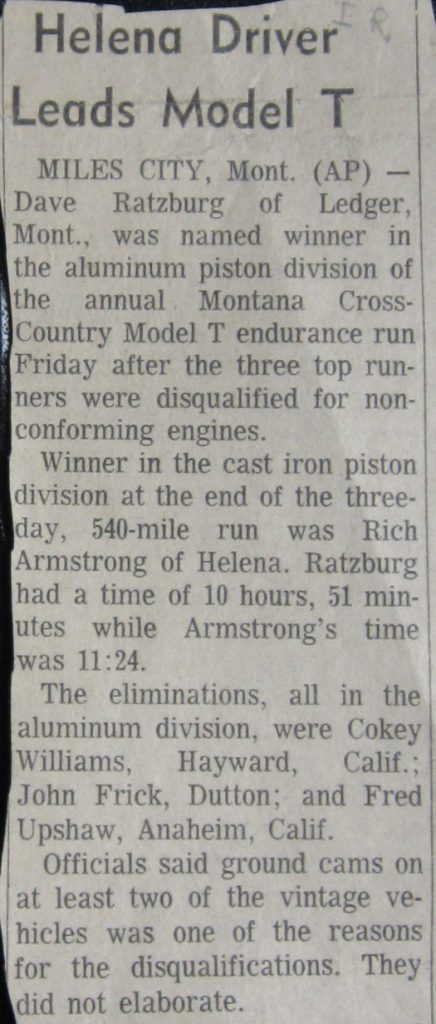
It was the late 1960’s, and Joe was visiting relatives, who lived in Montana. While he was there, a bunch of T’s came roaring through Livingston. He had run into one of the local T races that were popular all around the state of Montana at that time. Joe was intrigued, so when he got back to his home in Rocky Ford Colorado, he contacted the Livingston Chamber of Commerce to find out about the event. They in turn got him connected with the president of the Montana Cross Country T Association. He talked his friend, Ross Anderson, from Arlington Colorado into letting him use his T to run in the 1972 race out of Miles City. Joe and his racing buddy Ernie Woodring took turns driving Ross’s car to a 15th place overall finish. They were second in the cast iron division that year. By 1974 Joe and Ernie had their own car. They did not finish that year. In 1975 the gas shortage kept Joe home, but he was back in 1976 with his own car painted a bright
(Continued on page 10)
Page 9
(Continued from page 9)
NAPA yellow. He called his car the “Gold Hat Special”. He finished in 11th place that year. I remember in 1977 when he doled out gold hats (which we put to good use) to all the T drivers.

He came back most every year until 1981, which was his last year to race. His best finish was in 1980 when he came in 8th. Joe now lives in the Denver area.
Page 10
Through the Grapevine
Simon has sold his car to Josh Billmayer.
Doug Langel is putting his magic touch to a T motor.
Gary Ebbert got a cam that is a little more bumpier than a stock one.
Steve Coniff has designed a cam with nearly infinite lift and almost no duration. “Overlap kills the bottom end” Steve was quoted as saying.
We were saddened to hear the news that Melvin Lingle passed away this last month.
Harold Mann has given up on cast iron pistons.
Tom Carnegie has not. (yet)
Errata: I said last month that I didn’t know Bob Braun. It’s not true. I just didn’t know that the Bob Braun I knew was the Bob Braun.
Page 11
Montana 500 Newsletter
Mar-Apr 2001 Vol. 1 No. 2
Montana Cross Country T Assn.
7516 E. Mission, Spokane, WA 99212
www.antiqueautoranch.com/montana500
2001 Officers and Directors:
President: Sam Nickol
Vice President: Rick Carnegie
Sec.-Treasurer: Janet Cerovski
Directors:
Tom Carnegie
Tony Cerovski
Stan Howe
Doug Langel
George Nickol
Simon Nickol
Meeting Secretary: Carla Carnegie
Correspondence: Tom Carnegie
Date of endurance run is June 17th
Membership dues $10.00
Touring class: $25.00
Endurance runner: $35.00
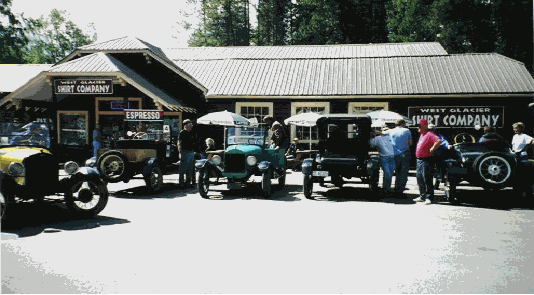
Cover picture: After the 2000 race,
West Glacier Shirt Company –
Thanks to Harold Mann
General News
The base hotel for 2001 will be the Best Western Outlaw Hotel, 1701 Highway 93 South, Kalispell, MT 59901. The rate is discounted to $85 per room and also includes a deluxe continental breakfast for two. For more persons, there would be a charge of $6 per person for the breakfast. This includes cereals, rolls, breads, hard boiled eggs, juice, coffee and milk. 15 rooms have been held. For those calling in, they need to mention “Model T endurance run”. The local number is 406-755-6864. Best Western toll-free reservation number is 800-528-1234. This hotel has amenities such as 2 indoor pools, 4 jacuzzis, sauna, tennis court, racquetball court, tanning and massage service, gift shop and western art gallery. Hennessy’s restaurant and lounge is on site. Rooms have coffee makers, TV with pay movies, fax or photo copy service upon request, in room data ports and high speed internet access, iron and ironing boards. The parking lot on the backside is reserved for the endurance run attendees, and those with a motor home are welcome to plug in in the same area. No one is under any obligation to stay at this
(Continued on page 4)
page 3
(Continued from page 3)
hotel. I have posted information about other hotels, motels and campsites on the webpage.
The rule changes were approved unanimously. I have posted the new rules on the web page. There were no actual changes, but rather clarifications of existing rules. Thanks to all who returned their ballots.
After your name on the address label, you will find a number. This number should correspond to the year for which your dues are paid. If it does not, please let me know. There seems to be some question as to when the dues are due. This is how I am treating the situation unless I am later told otherwise. The dues run from January 1st until December 31st. If you pay at race time you are paid until the end of the year. If you pay at the fall meeting, you are current until the end of the next year. This goes for new members too.
There are a couple more driver profiles, including one written by Gillian Hensley who is Bill Walters’ daughter. If anyone else wants to contribute a profile on a past driver, I would sure welcome it.
A special thanks to Vivian Peters for supplying me with much of the information I needed to fill in some of the gaps on the web page. We now have nearly all of the information from all of the races, such as who entered and their times.
Page 4
Your first Montana 500
A piece of fiction by Tom Carnegie.
You have been tweaking and tuning for the last two weeks, and now you feel that your T is ready for 500 miles of flat out driving. Up onto the trailer you drive her. It seems a shame to put your T in such an undignified place, but you must be practical. The drive to Montana is two days. The trip to Montana is uneventful. When you pull into the hotel parking lot, the large number of brightly colored T’s lets you know you are in the right place. You get out and stretch your legs. No sooner than you work out the first couple of kinks in your joints, someone is over talking to you, asking you where you are from and welcoming you to the run. You find out that several of the T’s have already been inspected. You aren’t sure exactly what that means, but you find out that it is a rather painless operation consisting of being fitted for a restrictor plate, having your engine sealed up, and a quick safety inspection. You look around, and notice one of the drivers has a coil tester, which he is somewhat earnestly cranking away on. You wander over his way, and before you know it, he has volunteered to tune up your coils. Couldn’t hurt, so tuned they get. An announcement is made of the upcoming drivers meeting. At the appointed time, the president goes over the route for the next day, meeting time and place and any other special
(Continued on page 6)
page 5
(Continued from page 5)
information that you might need. Numbers are drawn for starting positions. If Ed Towe shows up, he always gets the highest number (it’s a club tradition). After the meeting, people head to their hotel rooms, or go out to the parking lot to tune a little more, kick tires and swap lies.
You wake up bright and early. Out to the T you go. A few of the drivers are already warming up their motors. You decide to gas up and check the air in your tires. A half-hour or so before flag-out time one of the “locals” offers to lead you out to the starting line. Several T’s head out one after the other. When you get to the starting line, several of the low numbered cars have already lined up in order. You find your spot and get into line. At the top of the hour, out goes the first T. Soon the car in front of you goes. In one minute, it will be your turn. The longest minute of your life has just begun. You watch as the T before you becomes a speck, and then disappears. 15 more seconds to wait! Now 10 – Now 5 – 4 – 3 – 2 – 1 GO! The adrenaline is flowing as you ease in the low pedal – you don’t want to stall out now. Soon you are cruising down the highway. Your T sounds great and strong. You fiddle with the spark a little, fiddle with the carb a little. Everything is tuned to the max, and you and your T are as one. Now you start to relax a bit and it strikes you: this just may be the most beautiful country in the whole U.S., and this just might be the nicest day ever. After
(Continued on page 7)
Page 6
(Continued from page 6)
what doesn’t seem like enough time, you notice a speck in your rear view mirror. You turn around, and sure enough, a T is approaching you from behind. Slowly but surely he gains on you, until now, he is right behind you. The traffic is light, and soon he is around you. He gives you a friendly wave, and you watch as his bright green car pulls farther and farther away.
Around a couple more bends you notice that you are gaining on a car. Sure enough, it’s a T. It seems like a long time, but finally you’re right behind him. You notice as he frantically twiddles all manner of knobs and levers to try to coax just a little more speed out of his car. It’s no use. You’re going to pass him. The double yellow line goes away, and you make your move. Around him you go. You know just the wave to give him as you go by. What a thrill! You continue down the road on cloud nine. Oh – no! What’s that up ahead? It looks like a dead T along side the road. Sure enough, it’s your friend in the green T with his head under the dash, and his feet sticking out the driver’s door. You hope it isn’t too serious, and it probably isn’t – maybe wiring or a bad switch.
Soon you see the flagger up ahead and you pull into town. You love driving your T, but this is far and away the most fun you’ve ever had driving a T, and that’s saying a lot.
(the end)
page 7

page 8
Bill Walters
by Gillian Hensley
The Model T Racing Bug bit Bill in l960. He restored a 1925 Model T in the garage, painted it black and blue, and was off and running. His first competition was the 50-mile race Labor Day weekend in White Sulphur Springs, Mt. He placed 5th out of 27 starters and the racing bug had him good. Bill raced in the Cross Country T races from the beginning in 1961 until 1969. He helped form the Montana Cross Country T Association in 1962 and served several terms as a Director and was also President in 1965. He was also instrumental in forming the Bozeman Antique Auto Club in 1962.
Bill was a machinist for Montana Motor Supply in Bozeman, Mt. and worked on many “T” engines, grinding crankshafts, pouring babbitt bearings and basically kept the motors running for himself and many other racers. Summers for him and his children–David and Gillian (that’s me) were spent going
(Continued on page 10)
page 9
(Continued from page 9)
to the shorter 50 mile races held throughout the State, and the 3-day Cross Country race. Winters were spent working on engines and formulating ideas to get them to run faster–but stay within the rules. Bill never won the Cross Country (his best finish was 3rd twice), but thoroughly enjoyed each and every one he participated in, and especially enjoyed all the friendships he formed with other racers and their families.
In addition to his 1925 Model T used for racing, Bill also completely restored a 1915 Model T Touring Car–doing so on the sly and bringing it out for it’s maiden trip during a Bozeman Jaycees Parade. He also restored a 1924 Model T Coupe which his daughter Gillian raced several times in the 50 mile Bozeman race.
(note, Bill Walters, who was a charter member of the MCCTA, passed away in 1991, ed.)
Page 10

page 11
Loading Viewer…
1962 Aug. 28-30th
East Glacier to Helena to White Sulphur Springs to Circle.
Advertised mileage: 520 miles. Actual (trip planner) mileage: 546
| Pos. | Driver | Hometown | State | Car No. | Time | Avg. Speed 546 | Avg. Speed 520 |
| 1. | Leroy Schelly | Great Falls | MT | 14 | 12:01:57 | 45.38 MPH | 43.22 MPH |
| 2. | Hi-line Auto Club | Rudyard | MT | 3 | 12:02:43 | 45.33 MPH | 43.17:MPH |
| 3. | Bill Walters | Bozeman | MT | 12 | 12:29:05 | 43.73 MPH | 41.65 MPH |
| 4. | Fred Upshaw | Los Angeles | CA | 2 | 12:46:49 | 42.72 MPH | 40.69 MPH |
| 5. | Merle Sears | Townsend | MT | 8 | 12:56:48 | 42.17 MPH | 40.16 MPH |
| 6. | Russ Gensemer | Bozeman | MT | 11 | 13:03:59 | 41.79 MPH | 39.8 MPH |
| 7. | Joe Walsh | White Sulphur Springs | MT | 7 | 13:05:08 | 41.73 MPH | 39.74 MPH |
| 8. | Lewis Rector | San Leandro | CA | 13 | 13:42:00 | 39.85 MPH | 37.96 MPH |
| 9. | C. B. Halseth and Glenn Johnson | Dutton | MT | 9 | 13:49:05 | 39.51 MPH | 37.63 MPH |
| 10. | Bill Giese | Fairview | MT | 6 | 14:59:14 | 36.43 MPH | 34.7 MPH |
| 11. | Clifford De Jong | Oskaloosa | IA | 4 | 15:34:37 | 35.09 MPH | 33.38 MPH |
| 12. | Ken Cook | Bozeman | MT | 5 | 16:13:46 | 33.64 MPH | 32.04 MPH |
| Dick Schuler | Dutton | MT | 10 | -out- | |||
| Ed Towe | Circle | MT | 17 | -out- | |||
| John Frick | Dutton | MT | 16 | -out- | |||
| George Fitzgerald | Jordan | MT | 15 | -out- | |||
| Ray Habel | Dutton | MT | 1 | -out- |
1961 Sept. 16th – 19th
Missoula to Fairview traveling Highway 20 (now 200) the entire way.
Sept. 16th. Missoula to Lincoln to Great Falls
Sept. 17th. Great Falls to Stanford to Lewistown
Sept. 18th. Lewistown to Jordan to Circle
Sept. 19th. Circle to Fairview
Advertised mileage 575 or 552. Actual mileage (based on trip planner) 540 miles.
Average speed based on advertised mileage.
| Pos. | Driver | Hometown | State | Car No. | Time | Avg. Speed (575) | Avg. Speed (552) |
| 1 | Evan Lingle and Ensel Berg | Circle | MT | 16 | 11:25:51 | 50.3 | 48.29 |
| 2 | Ray Habel | Dutton | MT | 8 | 12:04:36 | 47.61 | 45.71 |
| 3 | Tom Stanton | Jordan | MT | 1 | 12:18:37 | 46.71 | 44.84 |
| 4 | Melvin Lingle | Wolf Point | MT | 21 | 12:23:39 | 46.39 | 44.54 |
| 5 | Leroy Schelly | Great Falls | MT | 7 | 12:26:39 | 46.21 | 44.36 |
| 6 | George Fitzgerald | Jordan | MT | 15 | 12:48:36 | 44.89 | 43.09 |
| 7 | Clifford De Jong | Oskaloosa | IA | 9 | 13:04:59 | 43.95 | 42.19 |
| 8 | John Frick | Dutton | MT | 14 | 13:17:07 | 43.28 | 41.55 |
| 9 | Hi-line Antique Auto Club | Rudyard | MT | 11 | 13:18:25 | 43.21 | 41.48 |
| 10 | Paul Winebarger | 29 Palms | CA | 10 | 13:25:20 | 42.84 | 41.13 |
| 11 | Joe Hoover | Los Angeles | CA | 3 | 13:40:20 | 42.06 | 40.37 |
| 12 | Bill Giese | East Fairview | ND | 12 | 14:09:40 | 40.6 | 38.98 |
| 13 | Ed Towe | Circle | MT | 22 | 14:15:27 | 40.33 | 38.72 |
| 14 | Bill Walters | Bozeman | MT | 2 | 14:25:11 | 39.88 | 38.28 |
| 15 | Claude Sims | Cat Creek | MT | 4 | 15:25:02 | 37.3 | 35.8 |
| 16 | Joe Walsh and Tom Watson | White Sulphur Springs | MT | 17 | 15:31:08 | 37.05 | 35.57 |
| 17 | A. B. Lee | Saratoga | IA | 19 | 16:03:03 | 35.82 | 34.39 |
| 18 | Lewis Rector | San Leandro | CA | 6 | 16:16:29 | 35.33 | 33.92 |
| 19 | Russell Gensemer | Bozeman | MT | 18 | 16:53:34 | 34.04 | 32.68 |
| 20 | Jim Gendreau | Great Falls | MT | 5 | 16:56:45 | 33.93 | 32.57 |
| Fred Upshaw | Los Angeles | CA | 13 | did not finish | |||
| Judge Brownlee and Arndt Zeller | Missoula | MT | 20 | did not finish | |||
| John Foos | Laurel | MT | 23 | ran in last two days only | |||
| Norman Kerr | Jordan | MT | 24 | ran in last day only |
These times are taken off of the official time sheet. There is
an addition error on the official times of Paul Winebarger, Bill
Giese, Bill Walters and Lewis Rector. Jim Gendreau was given an
official time even though he didn’t finish. None of the addition
errors caused a change of place. The next chart is the times
printed in the paper, which I believe are more accurate than the
official times. They seem to correspond to daily time sheets
still in existence. Average speed of top chart is based on 575
miles. Average speed of lower chart is based on 540 miles, which
is much closer to the actual miles traveled.
| Place | Name | Car No. | Total Time | Day 1 | Day 2 | Day 3 | Day 4 | Avg. Speed |
| 1 | Evan Lingle | 16 | 11:25:51 | 3:28:32 | 2:11:56 | 4:01:40 | 1:43:43 | 50.30 |
| 2 | Ray Habel | 8 | 12:04:36 | 3:47:33 | 2:20:25 | 4:08:41 | 1:47:57 | 47.61 |
| 3 | Tom Stanton | 1 | 12:18:37 | 3:41:22 | 2:21:55 | 4:21:56 | 1:53:24 | 43.21 |
| 4 | Melvin Lingle | 21 | 12:23:39 | 3:47:47 | 2:27:10 | 4:15:07 | 1:53:35 | 46.39 |
| 5 | Leroy Schelly | 7 | 12:26:39 | 3:43:23 | 2:24:10 | 4:26:30 | 1:52:36 | 46.21 |
| 6 | George Fitzgerald | 15 | 12:48:36 | 3:29:32 | 3:14:01 | 4:18:39 | 1:46:24 | 44.89 |
| 7 | Cliff De Jong | 9 | 13:04:59 | 4:19:44 | 2:23:32 | 4:24:20 | 1:57:23 | 43.95 |
| 8 | John Frick | 14 | 13:17:07 | 4:02:42 | 2:39:46 | 4:37:07 | 1:57:32 | 43.28 |
| 9 | Hi-Line | 11 | 13:18:25 | 4:39:06 | 2:25:50 | 4:28:16 | 1:45:13 | 43.21 |
| 10 | Paul Winebarger | 10 | 13:35:20 | 4:06:08 | 2:28:55 | 4:46:13 | 2:14:04 | 42.31 |
| 11 | Joe Hoover | 3 | 13:40:30 | 4:16:00 | 2:46:17 | 4:36:00 | 2:02:13 | 42.05 |
| 12 | Bill Giese | 12 | 14:00:40 | 4:07:18 | 2:47:45 | 4:36:30 | 2:29:07 | 41.04 |
| 13 | Ed Towe | 22 | 14:15:27 | 3:50:08 | 2:12:22 | 6:25:50 | 1:47:07 | 40.33 |
| 14 | Bill Walters | 2 | 14:26:11 | 3:53:24 | 2:15:36 | 6:25:50 | 1:51:21 | 39.83 |
| 15 | Claude Sims | 4 | 15:25:02 | 3:59:38 | 3:01:45 | 6:25:50 | 1:57:49 | 37.30 |
| 16 | Joe Walsh | 17 | 15:31:08 | 4:13:22 | 2:48:48 | 6:15:50 | 2:13:08 | 37.05 |
| 17 | A.B. Lee | 19 | 16:03:03 | 4:22:14 | 2:42:58 | 6:13:07 | 2:44:44 | 35.82 |
| 18 | Lewis Rector | 6 | 16:14:29 | 4:53:41 | 2:36:19 | 6:11:05 | 2:33:24 | 35.40 |
| 19 | Russ Gensemer | 18 | 16:53:34 | 5:20:00 | 2:33:51 | 6:25:50 | 2:33:53 | 34.04 |
| out | Jim Gendreau | 5 | dnf | 4:54:52 | 2:41:19 | 6:25:50 | 0:00:00 | |
| out | Judge Brownlee | 20 | dnf | 4:17:12 | 3:14:01 | 0:00:00 | 0:00:00 | |
| out | Fred Upshaw | 13 | dnf | 4:36:57 | 3:04:01 | 6:25:50 | 0:00:00 |
Below are the results as printed in the paper. The order begins to change with number 8.
| Place | Name | Car No. | Total Time | Day 1 | Day 2 | Day 3 | Day 4 | Avg. Speed |
| 1 | Evan Lingle | 16 | 11:25:51 | 3:28:32 | 2:11:56 | 4:01:40 | 1:43:43 | 47.24 |
| 2 | Ray Habel | 8 | 12:04:36 | 3:47:33 | 2:20:25 | 4:08:41 | 1:47:57 | 44.71 |
| 3 | Tom Stanton | 1 | 12:18:37 | 3:41:22 | 2:21:55 | 4:21:56 | 1:53:24 | 40.58 |
| 4 | Melvin Lingle | 21 | 12:23:39 | 3:47:47 | 2:27:10 | 4:15:07 | 1:53:35 | 43.57 |
| 5 | Leroy Schelly | 7 | 12:26:39 | 3:43:23 | 2:24:10 | 4:26:30 | 1:52:36 | 43.39 |
| 6 | George Fitzgerald | 15 | 12:48:35 | 3:29:32 | 3:14:00 | 4:18:39 | 1:46:24 | 42.16 |
| 7 | Cliff De Jong | 9 | 13:04:59 | 4:19:44 | 2:23:32 | 4:24:20 | 1:57:23 | 41.27 |
| 8 | Ed Towe | 22 | 13:15:27 | 3:50:08 | 2:12:22 | 5:25:50 | 1:47:07 | 40.73 |
| 9 | John Frick | 14 | 13:17:07 | 4:02:42 | 2:39:46 | 4:37:07 | 1:57:32 | 40.65 |
| 10 | Hi-Line | 11 | 13:18:25 | 4:39:06 | 2:25:50 | 4:28:16 | 1:45:13 | 40.58 |
| 11 | Bill Walters | 2 | 13:30:11 | 3:53:24 | 2:19:36 | 5:25:50 | 1:51:21 | 39.99 |
| 12 | Paul Winebarger | 10 | 13:36:20 | 4:06:08 | 2:28:55 | 4:47:13 | 2:14:04 | 39.69 |
| 13 | Joe Hoover | 3 | 13:40:30 | 4:16:00 | 2:46:17 | 4:36:00 | 2:02:13 | 39.49 |
| 14 | Bill Giese | 12 | 14:00:40 | 4:07:18 | 2:47:45 | 4:36:30 | 2:29:07 | 38.54 |
| 15 | Claude Sims | 4 | 14:25:02 | 3:59:38 | 3:01:45 | 5:25:50 | 1:57:49 | 37.46 |
| 16 | Joe Walsh | 17 | 14:31:07 | 4:13:22 | 2:48:47 | 5:15:50 | 2:13:08 | 37.19 |
| 17 | A.B. Lee | 19 | 15:02:57 | 4:22:14 | 2:42:52 | 5:13:07 | 2:44:44 | 35.88 |
| 18 | Lewis Rector | 6 | 15:14:29 | 4:53:41 | 2:36:19 | 5:11:05 | 2:33:24 | 35.43 |
| 19 | Russ Gensemer | 18 | 15:53:34 | 5:20:00 | 2:33:51 | 5:25:50 | 2:33:53 | 33.98 |
| out | Jim Gendreau | 5 | dnf | 4:54:52 | 2:41:19 | 5:25:50 | 0:00:00 | |
| out | Fred Upshaw | 13 | dnf | 4:36:57 | 3:04:01 | 5:25:50 | 0:00:00 | |
| out | Judge Brownlee | 20 | dnf | 4:17:12 | 0:00:00 | 0:00:00 | 0:00:00 |

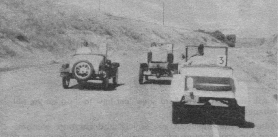
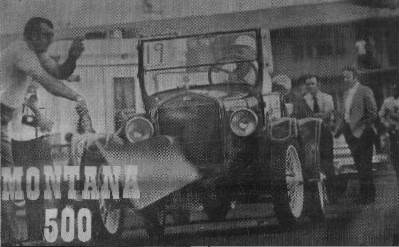
Across Montana’s highways streaks car #21 ahead of the pack in the Montana Model-T Cross-country Endurance Run. What an envious position for Association President, Al Rieker, Overcast skies, the wind at his back, first place was in the bag with an eleven minute lead and 542 miles behind him. Thirty miles to the checkered flag and thunk the crank shaft broke putting Al out of the running. Al’s breakdown wasn’t the only one, but certainly the most dramatic when twenty seven Ford T’s were pitted against Montana’s mountains & plains.
The Montana Model T Cross Country Endurance Run has been called many things. From the Great Montana T Race to the “T” Model Marathon. With coverage in such distinguished publications as Road & Track, The Vintage Ford, and Rod & Custom,thjs endurance run has grown to International fame.
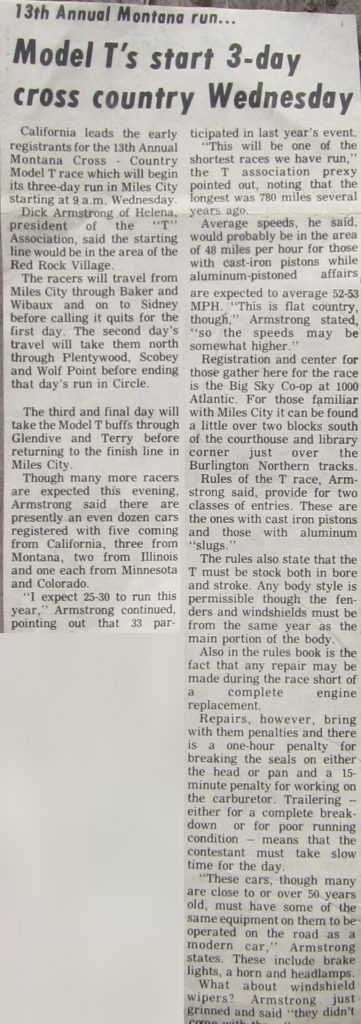
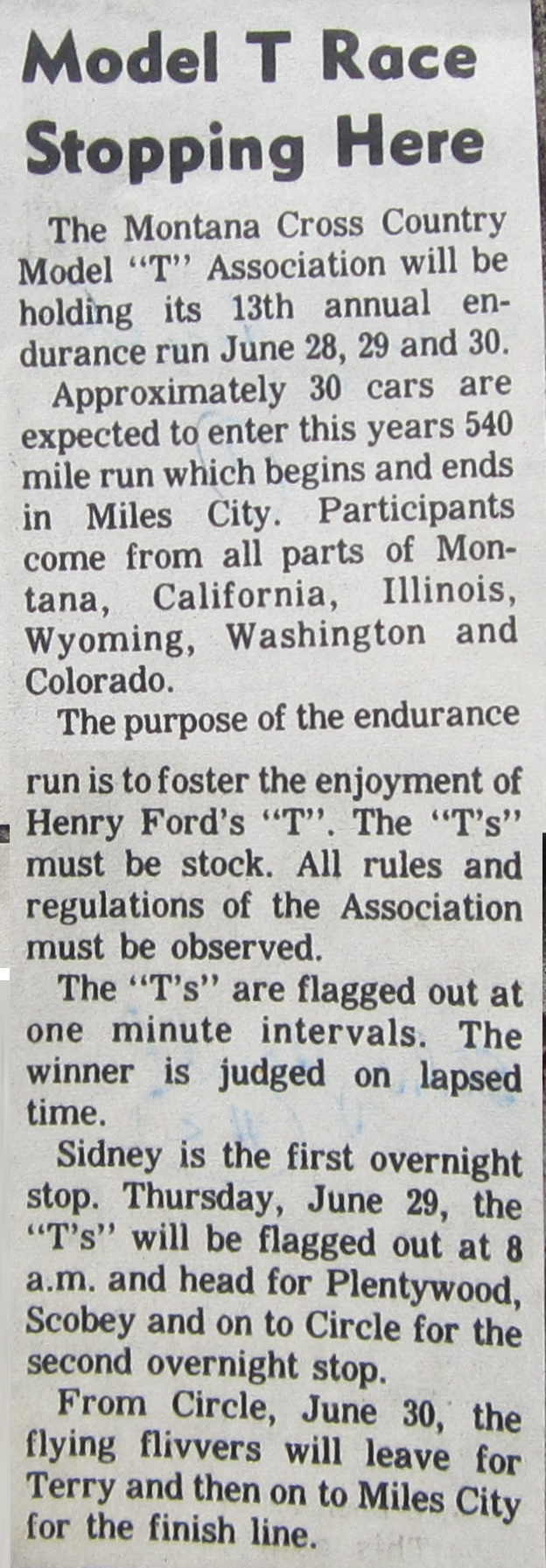
The 13th Annual Model “T” Endurance Run started at 9:00 A.M., June 27, within sight of the Capitol Building at Helena. First stop Great Falls for lunch, then on to Havre, where the Ford “T”s tied up for the might.
The first day was not without it’s trials. Car #4, driven by Phil Polillo never got out of sight of the Capitol before a rod gave out. John Morris, Phil’s partner, brought up the trailer and the car was taken to Havre, rebuilt that night. The team was given slow time for the day and time penalties. Car #4 faulted again the next day 20 miles out. The “T” lost its oil, overheated badly losing compression. Phil and John decided to leave the race, but plan to return next year.
The first day saw five more cars go under as the Fords followed interstate 15 along the Missouri River. John Foos with #12 was out of the running, but by the noon lunch plans were already formed to use #12’s differential in Norm Eberhardt’s car #27, who also broke down.
By the end of the first day the Fords had run themselves out of the Rockies into the Montana Highline Country at Havre. Spending the night here, the Association drivers and officers met that evening for a briefing on the run for the next day. Afterwards Clement Englmann of Chicago, Ill., treated the Association to a motion picture spectacular covering last year’s Endurance Run and other events. Mr. Englmann had some of the best footage I’ve seen.
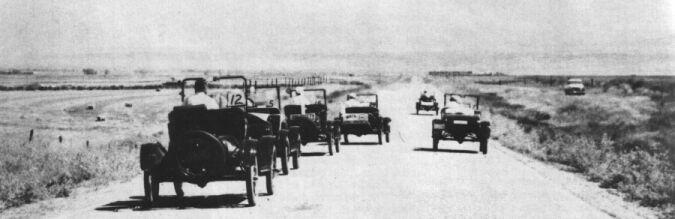
The second day saw the “T”s off Thursday morning running the Highline to Harlem, then to Lewistown and Harlowton for the overnight stop. The Highline Country affords the drivers the most freedom as the roads are flatter, straighter, and with less traffic. A hundred miles or more of T Roadsters trying to pass one another nip and tuck jockeying for time. many an enthusiast enjoyed this “out take” of a 1927 movie.
It had become overcast and the Fords drove into a down pour outside of Harlowton before tying up for the night In Harlowton the club was treated like royalty. The Chamber of Commerce put on a banquet, gave trophies and cash prizes, gave a tour of the town and stored the “T” cars out of the elements. It’s co-operation like this that makes the event. The last day the pack left Harlowton for a half day run into Helena, then stopping at White Sulpher Springs where the Jaycees gave the club a free coffee break. Next to Townsend then to the finish line.
Al Rieker from Boulder, Montana, lost his 1st place lead when his crank shaft broke and the Californians took the checkered flag. 1st place Scott Rawlings, 2nd John French and 3rd Jack. Collins. All three were from Lancaster, California.
In the Cast Classification was lst place Perry Matthews, 2nd Rich Armstrong, and 3rd Bill Shipley.
The tear downs themselves took about one hour and are very detailed. The pan, head folding windshields & other points not to be opened without the judges knowing are sealed before the race. A team of inspectors check each car meticulously, if any discrepancy appears they are disqualified and more cars are torn down until winners are confirmed. Last year three cars in the aluminum class were disqualified before winners were confirmed. This year there were no disqualifications. Mandatory tear downs are a key point here. By being club rules, no member has to challenge another. Hard feelings are avoided, unlike some clubs that require one person to post tear down bond to inspect another.
Needless to say these are not the bailing wire junkers that some would lead us to believe. Mechanically, they are perfection in stock “T” Fords. Sometimes the crank and trans are sent as much as 1500 miles away for balancing. We heard of differential gears and cranks, chrome plated to reduce friction. Of course you can always get a conversation going on the pros & cons of different types of banding material, they have tried them all.
The ability of men and cars is testified by over 14,000 miles driven in three days by 27 different drivers without an accident or traffic violation.
The top four cars in each class went to the mandatory tear downs at Placer Motors, Helena. The rest of the T’s gathered at the fairgrounds, where the trophies were later presented. A very accommodating Placer Motors moved four new Olds in order to make room for the Model “T” Club tear downs in front of their showroom.
All of the Association met at Bairs Truck Stop in Helena where arrangements had been made. The club enjoyed a fine meal in the Banquet Room before splitting up for the trophy awards.
At the Helena Fairgrounds the trophies and cash prizes were handed out with due ceremony and a keg of beer. President Al Rieker presiding. During the many interviews I never spoke to a club member that wouldn’t be back next year.
After the awards were over and I walked back to my truck thinking of the past three days, I thought brotherhood would be a better word than association for these guys. The acts of friendship, good sportsmanship, and yes, even heroism displayed in these 572 miles so typified the old car enthusiast. It’s no question but what the Montana 500 has earned its honorable place in the annuls of Model “T” History.