Loading Viewer…
Author: tm500
Loading Viewer…
Loading Viewer…
Loading Viewer…
There have been about 200 drivers enter the Montana 500 over the course of the last 40 years. Almost everyone who enters comes back another year to try it again. In fact about 80 percent of Montana 500 drivers return after their first try.
Not including current drivers (folks who have entered in the last five years) to date, there have been 34 people who have only entered one endurance run, they are: Judge Brownlee, Jim Gendreau, Joe Hoover, Norman Kerr, A. B. Lee, Melvin Lingle, Claude Sims, Tom Stanton, Tom Watson, Paul Winebarger, Arndt Zeller, Walt Mangold, Frank Schuler, Merle Clark, Clint Derby, Jim Faught, Bob Hunt, Laurin Cowling, Jeff Danielson, George Teves, Mavel Rector, Hugo Rintala, Hank See, John F. Cipra, Jr., C. E. “Andy” Anderson, Jim Stout, Ross Anderson, Jon DeVick, John Morris, Jon Bodine, Craig Rang, Jack Engdahl, Cort Strobel and Joyce Smith.
Of these 34, eleven were from the first year. Why there was such a drop out of first year people is beyond me. Of the remaining people, I only know one of them and that is Jon Bodine. I have been in touch with him and he says that he would like to come back some day. Jon ran in 1977 in a coupe. It was a bone stock original car right on down to the cast iron pistons. It never missed a beat in 500 miles and Jon finished with an respectable average speed of about 45 miles per hour.
by Tom Carnegie
Hal Wilson passed away recently. I knew him from when I ran in the Montana 500 in the seventies. I will describe my first impression of him. I don’t recall what year it was, but on this particular run his car was disqualified in the pre-race inspection because he had relocated his fuel tank underneath the dash instead of underneath the seat. At that time it was common to switch body parts around from year to year. His car had very early flat style fenders and a 1925 or so body. His thought was that since 1926-7 cars had their tank in the cowl, why not an earlier car? At some point in the pre-race meeting the drivers voted to overturn the inspectors’ and directors’ decision and allow Hal to run his car that year. I understand that Hal was a full-bird Colonel in the air-force and generally had the stoic demeaner fitting to the rank, but I could tell that he was affected by the show of support from the drivers.
The next year another car was disqualified at the start and Hal stood up at the prerace drivers’ meeting and made a motion to allow this fellow to run. The motion passed. Hal and several other fellows from Colorado were quite involved in T road racing and formed their own race called the Colorado 500 that ran for several years in Colorado. Hal was known to drive his model T (usually a brass roadster) great distances. He liked to drive from Colorado all the way into Canada and into the Arctic circle, often on primitive roads. He had articles published in both the Vintage Ford and the Model T Times.
As remembered by Nan Robison
My first recollection of Cokey Williams was in 1972. My brother Rick had decided to try his luck in the Montana 500 endurance run. My Mom and I had been enlisted as pit crew.
When we arrived on check in day, the multitude and variety of T’s amazed me. There were T’s of every color and condition, but one really stood out. That was Cokey’s. Cokey hailed from Hayward, CA. This was his second race, having entered in 1971. That year he placed 9th, and swore he would come back and win the 1972 race. He drove a 1924 and, he said that he was going to chrome everything if his car didn’t win in “71”. It didn’t, and he did.
Cokey stood out in a crowd. He was a very confident man, and while racing, always wore stylish coveralls, and a very natty chapeau. I constantly marveled at how his coveralls were always immaculate. I saw him in and under his car’s engine as often as any other driver. How he kept them so spotless is still a mystery to me.
His car in 1972 was a beaut! It was a sleek silver-gray and black 26-7 roadster, with Model A wheels, and lots of chrome. He had purchased the car at the Reno swap meet about 2 years before the race. It was a mass of rust and the turtle deck was riddled with bullet holes when he bought it. Cokey stated that “It looked like Bonnie and Clyde’s car”. You could see the filled bullet holes if you looked in the turtle deck. He estimated that he had spent about $1400.00 and 3000 hours restoring it to virtually mint condition. Rumor had it that he said it had somewhere between 21-47 coats of hand rubbed lacquer.
How many it actually had was never known for sure, but that car positively glowed. At that time, race rules required that you have a sign on the side of your car that stated your name and where you were from, but Cokey did not want to put one on his car as he was afraid it would mar the finish. He had made many of the parts he couldn’t find for the car himself. The car had a chrome Model A bumper, and both a brake light and a tail light, of which he was inordinately proud.
The race that year was 540 miles long. It began and ended in Miles City. Twenty-five cars were entered, with twenty-four starting. The first leg ended in Sidney, where Cokey led by nine minutes over Dave Ratzburg. He did have some sort of trouble outside of Plentywood, but still managed to come in ahead.
At the end of the race, Cokey came in first with a time of 10:39:54. He averaged 50.63 mph. After teardown, his car was found to have a cast iron head with a combustion chamber like a “Z” head. Whether it was legal or not was put to a vote of the drivers, and after the votes were counted, President Rich Armstrong said; “Sorry Cokey, it didn’t go your way”. His car was disqualified. He did not return in 1973.
by Steve Coniff and Tom Carnegie
It was the late 1960’s, and Joe was visiting relatives, who lived in Montana. While he was there, a bunch of T’s came roaring through Livingston. He had run into one of the local T races that were popular all around the state of Montana at that time. Joe was intrigued, so when he got back to his home in Rocky Ford Colorado, he contacted the Livingston Chamber of Commerce to find out about the event. They in turn got him connected with the president of the Montana Cross Country T Association.
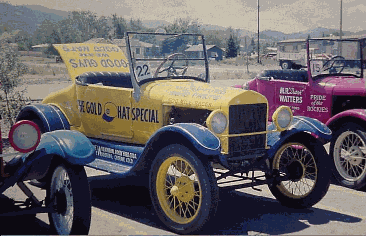
He talked his friend, Ross Anderson, from Arlington Colorado into letting him use his T to run in the 1972 race out of Miles City. Joe and his racing buddy Ernie Woodring took turns driving Ross’s car to a 15th place overall finish. They were second in the cast iron division that year. By 1974 Joe and Ernie had their own car. They did not finish that year. In 1975 the gas shortage kept Joe home, but he was back in 1976 with his own car painted a bright NAPA yellow. He called his car the “Gold Hat Special”. He finished in 11th place that year. I remember in 1977 when he doled out gold hats (which we put to good use) to all the T drivers.He came back most every year until 1981, which was his last year to race. His best finish was in 1980 when he came in 8th. Joe now lives in the Denver area.
by Gillian Hensley
The Model T Racing Bug bit Bill in l960. He restored a 1925 Model T in the garage, painted it black and blue, and was off and running. His first competition was the 50-mile race Labor Day weekend in White Sulphur Springs, Mt. He placed 5th out of 27 starters and the racing bug had him good. Bill raced in the Cross Country T races from the beginning in 1961 until 1969. He helped form the Montana Cross Country T Association in 1962 and served several terms as a Director and was also President in 1965. He was also instrumental in forming the Bozeman Antique Auto Club in 1962.
Bill was a machinist for Montana Motor Supply in Bozeman, Mt. and worked on many “T” engines, grinding crankshafts, pouring babbitt bearings and basically kept the motors running for himself and many other racers. Summers for him and his children-David and Gillian (that’s me) were spent going to the shorter 50 mile races held throughout the State, and the 3-day Cross Country race. Winters were spent working on engines and formulating ideas to get them to run faster–but stay within the rules. Bill never won the Cross Country (his best finish was 3rd twice), but thoroughly enjoyed each and every one he participated in, and especially enjoyed all the friendships he formed with other racers and their families.
In addition to his 1925 Model T used for racing, Bill also completely restored a 1915 Model T Touring Car-doing so on the sly and bringing it out for it’s maiden trip during a Bozeman Jaycees Parade. He also restored a 1924 Model T Coupe which his daughter Gillian raced several times in the 50 mile Bozeman race.
(note, Bill Walters, who was a charter member of the MCCTA, passed away in 1991, ed.)
By Tom Carnegie
Bud Peters of Ledger, MT. first entered the Montana 500 in 1963 and didn’t miss many times after that. He ran every year from 1963 through 1994. 1998 was the last time Bud entered. In 1981 Bud got his first top five finish and finished in the top five most years after that. Bud won his first time in 1982. Between then and 1993, Bud won four more times, making him the only five time winner of the open division.
Bud spent most of his life in the Ledger area. During WWII, Bud was in the U.S. Army Corps of Engineers. After his discharge he started working on farms around the Ledger area. When his parents retired, Bud began farming the Peter’s farm. I visited Bud this summer and one of the things he showed me was his first grain storage shed, which he hand made by nailing two-by-fours one on top of the other to make solid four-inch thick walls. There were now several metal storage bins to replace the hand made one. The hand made one was full of T parts (of course)
Most people who knew Bud knew him as a fun and funny, witty man. He also was a musician. He told me that he liked to go to the retirement home and play his accordion for his friend Dave Ratzburg. Bud had a huge impact on the Montana 500 and many of the policies and rules are the direct or indirect result of his input.
This March, Bud passed away. He will be missed very much by all of his friends.
Tillman Oblander grew up in Oklahoma. Later, he left home and moved to La Grange Park, Illinois, where he met Don and Clem Englmann. The Englmanns got Tillman interested in joining the Montana Cross Country T Association. Tillman Oblander first entered the Montana 500 in 1974. That year he placed fourth in the cast-iron division. In 1975 he returned, came in second in the cast-iron division, but was disqualified.
I talked to Tillman recently and asked him about his disqualification. He was a bit cagey, but did mumble something about their being “something wrong” with the carburetor. He was a little bit put out about coming all the way from LaGrange Park Illinois, only to be disqualified, and wondered if it was worth all the trouble to even come next year. Some of his friends from Montana talked to him and convinced him it was indeed worth the effort.
He came back in 1976 and finished 2nd in the cast iron division. In 1977 the cast iron class was eliminated. Tillman finished 27th out of 27 finishers that year. In 78 he was up to 5th out of 14. In 79, 80 and 81 he entered but did not finish. 1982 brought 2nd place, his best finish. He entered from 1983-85. He took off 86 and 87 but came back in 1988, 1992 and 1993 which was his last year. Tillman now lives in Ozark, Missouri
By Tom Carnegie with help from Bob Braun
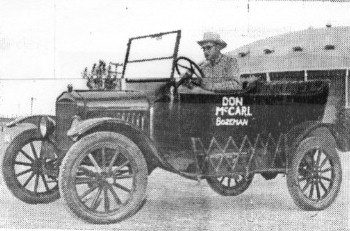
Don Mc Carl was part of the group that came from Bozeman. He ran in 1965 and 1966, which were the largest races based on the number of drivers that entered. In 1965 there were 35 drivers and in 1966 there were 36. 1965 was the year that the route took the drivers up into Canada. It was also during this run
that Glenn Embree filmed most of the footage for his motion picture called Flying Flivvers. Apparently this excursion into Canada caused some interesting episodes with washed out roads and such like that.
Bob Braun, who was also from Bozeman, recently told me a little story about this situation. Because the roads had some problems, the drivers had adopted a signal (raising their hand above their head) to show when they were going to slow down for a bad spot. Don and Bob had a friendly rivalry going. Bob’s car was generally faster than Don’s but Don was always telling Bob, “I’m going to catch you on this leg”.
On one particular leg Don’s T was running well and it looked like he was going to catch Bob. Just as he was about to make his move, Bob raised his hand. Don apparently thought this a trick so he continued at speed. It wasn’t, as indeed there was a big bump in the road. As Don hit the bump he was thrown out of control and went off the road. Bob stopped to help him and both drivers were shaken but not hurt and continued on. Don was one of the few people that has run a touring car. Today this exact car can be found at the home of Mark Hutchinson. It still has the signs on the door!